

Plastic Granules for Mesh and Lace Fabric Production: Natural vs. Pre-Colored Pellets Explained


Mesh and lace fabrics — the lightweight, openwork textiles used in everything from hosiery and lingerie linings to curtains, packaging nets, and technical textiles — almost always begin their life not as fiber, but as small plastic pellets known as granules or resin pellets. Understanding how these granules are produced, and the difference between natural (colorless) and pre-colored variants, is essential for manufacturers sourcing raw material, converters running extrusion lines, and buyers evaluating fabric quality from the ground up.
This article walks through what granules are, how they’re transformed into mesh-grade yarn, and why the choice between natural and colored pellets affects cost, production speed, and final fabric performance.
Why Raw Material Choice Comes Before Everything Else
It’s tempting to think of fabric quality as something decided at the loom or the knitting machine. In reality, much of what determines the final look, feel, and durability of a mesh or lace fabric is locked in long before that — at the moment a manufacturer chooses which granules to feed into the spinning line. Melt viscosity, pigment load, moisture content, and pellet uniformity all travel downstream into the yarn, and from the yarn into the finished fabric. A converter can fine-tune machine settings to compensate for some raw-material inconsistency, but no amount of downstream adjustment fully corrects for a poor-quality or mismatched granule batch. That’s why sourcing teams increasingly treat granule selection as a quality-control decision, not just a procurement one.
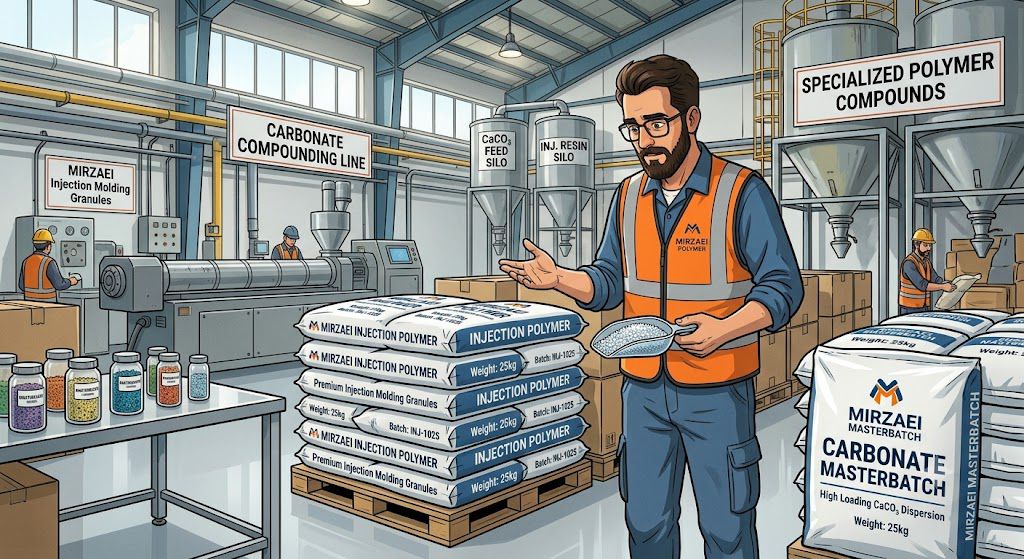
What Are Plastic Granules in Textile Manufacturing
In the context of synthetic fiber production, granules are small, uniform pellets of polymer resin — typically polyamide (nylon) or polyester (PET) — that serve as the feedstock for melt-spinning into filament yarn. These pellets are produced by polymer manufacturers through a process of polymerization followed by extrusion and cutting, resulting in a consistent, free-flowing material that’s easy to store, transport, and feed into spinning machinery.
For mesh and lace fabrics specifically, the yarn produced from these granules needs particular characteristics: fine denier, good elasticity (often achieved by blending in a small percentage of spandex/elastane at the yarn stage), and a smooth surface that knits cleanly into open, lattice-like structures.
From Pellet to Yarn: How Granules Become Mesh-Ready Filament
It’s worth understanding the mechanical journey a granule takes before it ever resembles fabric, since each stage introduces a point where natural and pre-colored pellets behave differently.
Drying. Polyamide and polyester granules are hygroscopic, meaning they absorb moisture from the air during storage. Before spinning, pellets are dried in a hopper or desiccant dryer to a strict moisture threshold — typically well below 0.1% for nylon — because residual moisture causes hydrolysis during melting, weakening the resulting filament and creating brittle, inconsistent yarn.
Melting and extrusion. Dried granules are fed into an extruder, where heat and mechanical pressure melt them into a viscous polymer fluid. This molten polymer is then forced through a spinneret — a metal plate with dozens or hundreds of microscopic holes — to form continuous filament strands.
Cooling and drawing. As filaments emerge from the spinneret, they’re cooled (usually by a cross-flow of air) and then mechanically drawn, or stretched, to align the polymer molecules along the fiber axis. This drawing step is what gives synthetic yarn its tensile strength and is calibrated differently depending on the target denier.
Texturizing or twisting. Depending on the final fabric’s intended hand-feel, filament may be texturized (given a slight crimp for bulk and softness) or twisted with elastane to create the stretch needed for body-conforming mesh.
Knitting or weaving. The finished yarn is fed into circular knitting machines (for tubular hosiery-style mesh) or warp/weft knitting machines (for flat lace and net fabrics), where the open, lattice-like mesh structure is formed.
Natural and pre-colored granules pass through essentially the same five stages, but pre-colored pellets carry pigment through every step, meaning extruder cleaning between color changes becomes a meaningful production-planning factor — color changeovers on a line running masterbatch pellets typically take longer to purge than a line running uncolored resin.
Natural (Colorless) Granules
Natural granules — sometimes called “virgin” or “uncolored” pellets — are the resin in its base state, with no pigment added during polymerization. They typically have a slightly milky or translucent appearance.
Key characteristics:
Maximum flexibility for dyeing: Because no color has been locked into the polymer, fabric woven from natural granules can be dyed to virtually any shade after weaving or knitting, making this the preferred choice for manufacturers producing fabric in many different colorways from a single production run.
Better suited for sheer, skin-tone, or pastel fabrics: Since pigment-free yarn doesn’t compete with dye absorption, it generally produces cleaner, more even results for light and nude shades — a common requirement for mesh used in hosiery and lingerie linings.
Slightly higher processing cost downstream: Because coloring happens later in a separate dyeing or printing stage, total production involves an additional step (and the associated water, energy, and dye costs) compared to pre-colored material.

Pre-Colored Granules (Masterbatch Pellets)
Pre-colored granules — produced using a technique called masterbatch coloring — have pigment concentrate compounded directly into the polymer before or during pellet formation. The color is therefore fixed at the raw-material stage, before the resin is ever spun into yarn.
Key characteristics:
Faster, leaner production: Since color is already built in, manufacturers skip the separate dyeing stage entirely, which shortens lead times and reduces water and chemical usage — an increasingly important factor as buyers prioritize lower-impact production methods.
Excellent color consistency batch-to-batch: Because pigment is dosed precisely during compounding, pre-colored granules tend to produce more uniform color across large production runs compared to fabric dyed after the fact, where dye-bath variation can cause subtle shade differences between lots.
Best for solid, saturated colors: Masterbatch pellets are particularly well suited to producing strong, consistent shades — black, navy, red, and other solid colors — at scale.
Less flexible for custom shade-matching: Once granules are pre-colored, the resulting yarn is committed to that color family; achieving a brand-specific or highly custom shade typically requires ordering a custom masterbatch batch rather than adjusting on the fly.
Natural vs. Pre-Colored: A Side-by-Side Comparison
| Factor | Natural (Colorless) Granules | Pre-Colored Granules (Masterbatch) |
|---|---|---|
| Color applied | After spinning/knitting (dye stage) | Before spinning (compounded into resin) |
| Best for | Sheer, nude, pastel, or fully customizable colorways | Solid, saturated, high-volume standard colors |
| Production steps | Spinning → knitting → dyeing | Compounding → spinning → knitting |
| Color consistency | Depends on dye-bath control | Generally more consistent batch-to-batch |
| Water/chemical use | Higher (separate dye stage) | Lower (no separate dyeing required) |
| Flexibility | High — any shade possible later | Lower — color is fixed at the pellet stage |
? Why This Choice Matters for Mesh and Lace Fabric Specifically
Mesh and lace structures are open-knit fabrics with a high surface-area-to-weight ratio, which makes them more sensitive to dye uptake and color evenness than denser, tightly woven fabrics. This has a few practical implications for manufacturers:
A.Open structures show dye unevenness more readily. A poorly controlled dye bath on an open mesh fabric will reveal streaking or patchiness far more visibly than it would on a solid weave, which is one reason many fine-gauge sheer mesh producers favor natural granules paired with carefully controlled, small-batch dyeing.
B. Pre-colored granules reduce risk for high-volume standard runs. For mass-produced mesh in common colors like black or beige, masterbatch pellets reduce the number of variables in the production line and help maintain consistency across large orders.
C. Denier and granule choice are linked decisions. Finer-denier mesh (used in lighter, more transparent fabrics) tends to be more forgiving with natural granules and post-dyeing, since lower-mass yarn absorbs dye more evenly than thicker yarn.
Sustainability Considerations in Granule Selection
Environmental impact has become a meaningful factor in granule sourcing decisions, not just a marketing talking point. A few specific considerations stand out for mesh and lace producers:
Water usage. Conventional dye-bath coloring of natural-granule yarn or fabric is one of the more water-intensive steps in textile production. Pre-colored masterbatch pellets eliminate this step entirely, which is one of the clearest sustainability advantages of solid-color, high-volume production.
Recycled content compatibility. Recycled polyamide and polyester (often labeled rPA or rPET) are increasingly available as granules, frequently sourced from post-consumer plastic or pre-consumer manufacturing waste. Recycled resin can generally be used in either natural or pre-colored form, though recycled feedstock sometimes carries a faint inherent tint that limits how light or pure a “colorless” result can be — a detail worth confirming with suppliers if a bright-white or fully transparent sheer mesh is the goal.
Energy use in coloring. Masterbatch compounding is typically a single, controlled industrial process, whereas dye-bath coloring requires heating large volumes of water and, in some processes, additional steps to fix dye to synthetic fibers. For buyers tracking the carbon footprint of a product line, this is a meaningful point of difference between the two approaches.
Effluent treatment. Dye-house wastewater requires treatment before discharge in most regulated markets, adding both cost and environmental oversight requirements that pre-colored production sidesteps.
None of this makes one approach universally “better” — a manufacturer producing twenty custom nude shades for a lingerie brand still needs the flexibility of natural granules and post-dyeing, water cost included. But for buyers and manufacturers weighing sustainability claims, it’s useful to know precisely where in the process those gains (or trade-offs) actually occur.
Sourcing Considerations for Buyers and Manufacturers
When evaluating granule suppliers for mesh or lace fabric production, a few questions are worth asking directly:
Polymer grade and intended end-use: Textile-grade polyamide or polyester differs from packaging- or industrial-grade resin in melt viscosity and spinnability; confirm the grade is suited for fine-filament spinning.
Pigment dispersion quality (for masterbatch): Poorly dispersed pigment can cause visible specks or uneven color in the finished yarn; request dispersion test data or sample yarn before committing to a large order.
Consistency certification: Ask for batch-to-batch consistency data, particularly for pre-colored granules intended for large, continuous production runs.
Compliance and safety documentation: For textiles used in apparel and intimate-wear linings, confirm the resin and any pigments used meet relevant chemical safety standards (such as OEKO-TEX or REACH compliance, depending on your target market).
Frequently Asked Questions
Are natural granules more expensive than pre-colored granules? Not inherently — the granules themselves are often similarly priced. The cost difference shows up downstream: natural granules require a separate dyeing stage (adding labor, water, energy, and chemical costs), while pre-colored granules shift that cost earlier, into the masterbatch compounding step. Which option is cheaper overall depends on order volume, the number of colorways needed, and whether dyeing capacity is already in-house.
Can natural and pre-colored granules be blended on the same production line? Yes, but not within the same run without a full purge of the extruder and feed lines. Switching from a pre-colored resin to natural resin (or between two different colors) requires flushing residual polymer to avoid streaking or contamination in the new batch — a routine but time-consuming part of production planning.
Does the choice of granule affect how the fabric feels, not just its color? Indirectly, yes. Pigment loading in masterbatch pellets can very slightly affect melt flow during extrusion, which in turn can influence filament uniformity. Well-formulated masterbatches are engineered to minimize this effect, but it’s one more reason buyers should request sample yarn rather than relying on color alone when qualifying a new granule supplier.
Is one option better for stretch and elasticity? Granule color has no direct effect on elasticity — that property comes primarily from the polymer type and the percentage of spandex/elastane blended in at the yarn stage, not from whether the base resin was colored or left natural.
How do I know which option is right for a specific mesh product? As a general guide: if the product line needs many custom or nude shades and color flexibility matters more than speed, natural granules with controlled dyeing are the better fit. If the product is a high-volume item in a small number of standard solid colors, pre-colored masterbatch pellets usually offer faster turnaround and more consistent results at scale.
Conclusion
The decision between natural and pre-colored granules isn’t simply a cost question — it shapes how flexible a production line can be, how consistent the final color will look across large orders, and how well-suited the resulting yarn is to delicate, open-structure fabrics like mesh and lace. Manufacturers producing a wide range of custom shades, particularly sheer or nude tones, generally lean toward natural granules and controlled post-dyeing, while those running high-volume standard-color production benefit from the speed and consistency of pre-colored masterbatch pellets. Understanding this distinction at the raw-material stage is the foundation for predictable quality further down the production line.